Learn how to test and correct the Ileocecal Valve
Who is the ICV Course for?
This course is open to anyone who has taken either the TASK Foundation course or an equivalent recognised course and is competent in muscle testing.
Join us to learn this valuable addition to your toolkit. Practitioners and families alike can benefit from knowing how to test and correct the Ileocecal Valve (ICV). The course presents a full testing and correction protocol in a clear and practical way, supported by detailed full-colour notes that provide a step-by-step guide to the techniques taught.
A Malfunctioning Ileocecal Valve is an Extremely Common Condition
Come and learn this must-have technique whether you are a practitioner expanding your skill set or someone wishing to support the health of yourself, your family and friends.
A malfunctioning Ileocecal Valve can be responsible for an almost unbelievable range of distressing symptoms. It is frequently the cause of the feeling that “I just don’t feel well”, as well as many types of pain including neck pain, lower back pain, inflamed joints, brain fog, low energy, loose bowels, constipation, IBS and many other symptoms.
The majority of clients presenting with a range of symptoms to a complementary health practitioner — and probably also to medical doctors — will have a problem with the Ileocecal Valve that is either primary to their issues or a significant contributing factor.
Every Client Needs to be Tested for ICV Involvement
Practitioners are often drawn to focus on a client’s main point of pain. However, this can sometimes cause ICV involvement to be missed.
Even conditions such as Carpal Tunnel Syndrome and disc problems, which appear to involve peripheral nerve irritation, can be considerably exacerbated by water retention in the body as it attempts to dilute the toxins produced by an ICV malfunction.
Location of the Ileocecal Valve
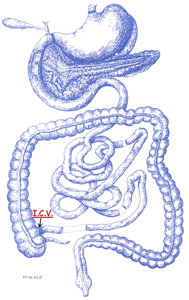
The Ileocecal Valve is located between the end of the small intestine (the ileum) and the beginning of the ascending colon (the caecum).
A commonly used reference point is McBurney’s Point, located diagonally between the right Anterior Superior Iliac Spine and the navel. The Ileocecal Valve lies behind this point, although anatomical positioning varies slightly between individuals.
Structure and Function of the Valve
The valve is composed of two parts:
- A sphincter muscle at the end of the ileum, which is under neurological control
- A valve structure at the beginning of the caecum, which functions mechanically
Historically the Ileocecal Valve was thought to function simply as a one-way valve maintained by its shape. However, Systematic Kinesiology reinforces the understanding that the valve is muscular and operates under autonomic nervous system control.
Emotional and Digestive Influences
Emotional factors also appear to play a role through their connection to the Limbic System. Our “gut reaction” to stress and emotional upset can affect the function of the valve.
Within kinesiology we look at:
- Digestion in the stomach
- Absorption in the small intestines
- The intestinal environment within the large intestine
During the course you will also learn how to test for food sensitivities, as these can affect ICV function.
Format of the Course, Venue and Cost
This is a two-day course running from 9.30am to 5.30pm each day.
Participants receive comprehensive course notes and a certificate for Continuing Professional Development (CPD) on completion.
Cost: £350
Tutors
Lottie Moffat
Claire Muller
Bookings
To book your place, please email us on info@kinesiology.co.uk
or telephone the office on 020 8391 5988.
Spaces are limited.
Next Available Dates
Please see the Course Dates page or contact the office for information on the next available training dates.