If you’ve read our previous blog — 31 Ways Rebounding Can Improve Your Wellbeing — you’ll already know that we’re big fans of the mini trampoline here at TASK. However we’d like to have a deeper conversation about Point 5: Aids lymphatic circulation by stimulating the millions of one-way valves in the lymphatic system.
The System Nobody Talks About (well almost nobody…we do!)
Most of us grew up learning about the heart pumping blood around the body. We understood that — it made sense. But very few of us were ever taught about the lymphatic system, even though it runs alongside our circulatory system and is absolutely essential to how we feel day to day.
The lymphatic system is a vast network of vessels, nodes, and organs that acts as the body’s primary waste management and immune defence system. It collects excess fluid, waste products, toxins, bacteria, and dead cells from the tissues and transports them to be filtered and removed from the body.
Unlike the cardiovascular system, the lymphatic system has no pump. The heart moves blood. Nothing moves lymph — except you.
Lymph fluid relies entirely on movement, breathing, and muscle contractions to circulate. When we are sedentary, it stagnates. And stagnant lymph can show up in ways that might surprise you.
What Sluggish Lymph Can Look Like
In clinic, we often see clients who have been struggling with symptoms they can’t quite explain — persistent puffiness, swollen glands, a feeling of heaviness or fatigue that doesn’t shift with rest, recurring colds, skin problems, or a general sense of being “congested” even when they don’t have a cold.
Digestive issues, headaches, and brain fog are also commonly linked to poor lymphatic flow.
None of these symptoms come with a neat label saying lymphatic system under-performing, and that’s part of why they’re so often overlooked by conventional approaches. In Systematic Kinesiology, we look at the body as a whole using the MCPE appraoch — the mental (emotional), chemical, physical, energetic — and the lymphatic system sits right at the heart of that.
But what can you do at home, to help move your lympatic fluid? This is where rebounding comes in.
Why Bouncing Is So Effective
The lymphatic system is filled with tiny one-way valves. These valves open and close to move lymph fluid in the right direction — always towards the lymph nodes, where it can be filtered.
What triggers those valves to open and close? Changes in gravitational force. Up and down. Compression and release.
When you bounce on a rebounder (mini trampoline), your body experiences a rapid, repeated shift between increased gravity (as you land) and a brief moment of near-weightlessness (as you rise). This happens with every single bounce. And each time, those millions of lymphatic valves are stimulated to open and close in rhythm — pumping fluid through the system far more efficiently than walking or most conventional forms of exercise can achieve.
The famous NASA study that found rebounding to be 68% more effective than jogging? The researchers were initially looking at cardiovascular fitness — but the lymphatic benefits are arguably just as significant.
It Moves More Than Just Lymph
When lymph starts to flow properly, a lot of other things shift too.
Waste products and toxins that have been sitting in the tissues get picked up and moved along. The immune system — around 70% of which lives in the gut and lymphatic tissue — gets a genuine boost. Fluid retention often reduces. Energy improves. Skin can begin to look clearer. Digestion settles.
How to Get Started
You don’t need to commit to 45 minutes of intense bouncing. In fact, for lymphatic benefits especially, a gentler approach is often just as effective — and far more sustainable.
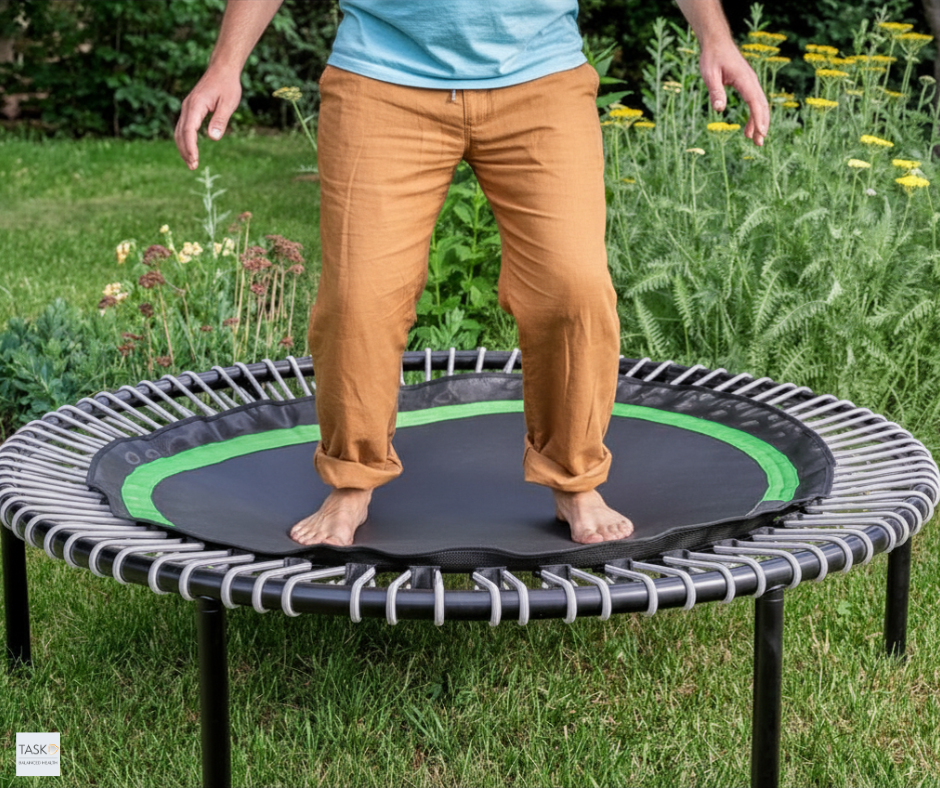
Even a health bounce — where your feet stay in contact with the rebounder and you simply move up and down in a rhythmic, gentle way — is enough to get lymph moving. This is particularly useful for anyone with joint issues, who is recovering from illness, or who is just starting out.
Five to ten minutes a day is a meaningful starting point. Build gradually. Notice how you feel. Some people find mornings work well; others prefer an afternoon bounce when energy dips. There’s no single right answer.
A Final Word
The lymphatic system is one of those things that, once you truly understand it, changes how you think about health altogether.
A rebounder is one of the most effective tools you can own for supporting it. It costs less than a gym membership, takes up very little space, it’s fun and you can use it in your living room in your pyjamas.
If you’re experiencing any of the symptoms mentioned in this blog and would like to explore what might be going on at a deeper level, Systematic Kinesiology may be able to help. Find out more about our Foundation Course or locate a practitioner near you.